


Page 2 - Demo
P. 2
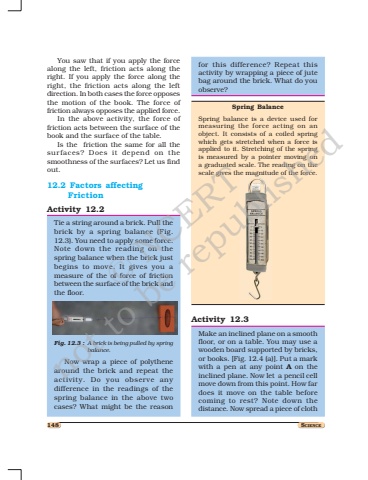
148 SCIENCEYou saw that if you apply the forcealong the left, friction acts along theright. If you apply the force along theright, the friction acts along the leftdirection. In both cases the force opposesthe motion of the book. The force offriction always opposes the applied force.In the above activity, the force offriction acts between the surface of thebook and the surface of the table.Is the friction the same for all thesurfaces? Does it depend on thesmoothness of the surfaces? Let us findout.12.2 Factors affectingFrictionActivity 12.2Tie a string around a brick. Pull thebrick by a spring balance (Fig.12.3). You need to apply some force.Note down the reading on thespring balance when the brick justbegins to move. It gives you ameasure of the of force of frictionbetween the surface of the brick andthe floor.for this difference? Repeat thisactivity by wrapping a piece of jutebag around the brick. What do youobserve?Fig. 12.3 : A brick is being pulled by springbalance.Now wrap a piece of polythenearound the brick and repeat theactivity. Do you observe anydifference in the readings of thespring balance in the above twocases? What might be the reasonSpring BalanceSpring balance is a device used formeasuring the force acting on anobject. It consists of a coiled springwhich gets stretched when a force isapplied to it. Stretching of the springis measured by a pointer moving ona graduated scale. The reading on thescale gives the magnitude of the force.Activity 12.3Make an inclined plane on a smoothfloor, or on a table. You may use awooden board supported by bricks,or books. [Fig. 12.4 (a)]. Put a markwith a pen at any point A on theinclined plane. Now let a pencil cellmove down from this point. How fardoes it move on the table beforecoming to rest? Note down thedistance. Now spread a piece of cloth%u00a9 NCERTnot to be republished


