


Page 3 - Demo
P. 3
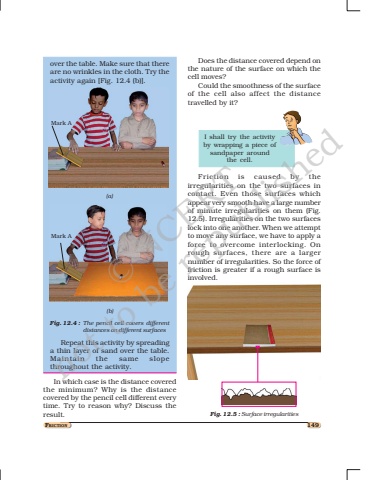
FRICTION 149Fig. 12.5 : Surface irregularitiesover the table. Make sure that thereare no wrinkles in the cloth. Try theactivity again [Fig. 12.4 (b)].Does the distance covered depend onthe nature of the surface on which thecell moves?Could the smoothness of the surfaceof the cell also affect the distancetravelled by it?(a)(b)Repeat this activity by spreadinga thin layer of sand over the table.Maintain the same slopethroughout the activity.In which case is the distance coveredthe minimum? Why is the distancecovered by the pencil cell different everytime. Try to reason why? Discuss theresult.Fig. 12.4 : The pencil cell covers differentdistances on different surfacesI shall try the activityby wrapping a piece ofsandpaper aroundthe cell.Friction is caused by theirregularities on the two surfaces incontact. Even those surfaces whichappear very smooth have a large numberof minute irregularities on them (Fig.12.5). Irregularities on the two surfaceslock into one another. When we attemptto move any surface, we have to apply aforce to overcome interlocking. Onrough surfaces, there are a largernumber of irregularities. So the force offriction is greater if a rough surface isinvolved.Mark AMark A%u00a9 NCERTnot to be republished


