


Page 8 - Demo
P. 8
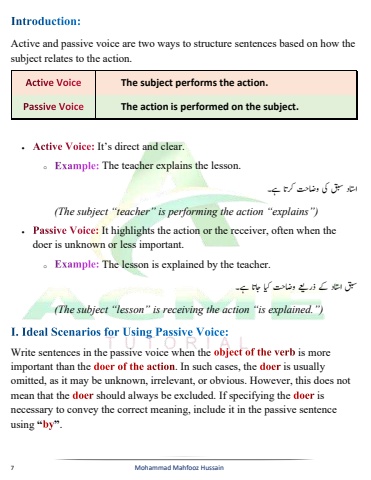
7 Mohammad Mahfooz HussainIntroduction:Active and passive voice are two ways to structure sentences based on how the subject relates to the action.Active Voice The subject performs the action.Passive Voice The action is performed on the subject.%u2022 Active Voice: It%u2019s direct and clear. o Example: The teacher explains the lesson. %u0648%u0627%u0636%u062d %u0627%u0627%u062a%u0633%u062f %u0642%u0628%u0633 %u06a9 %u06a9%u06cc %u06d2%u06c1%u06d4 (The subject %u201cteacher%u201d is performing the action %u201cexplains%u201d)%u2022 Passive Voice: It highlights the action or the receiver, often when the doer is unknown or less important.o Example: The lesson is explained by the teacher.%u0642%u0628%u0633 %u0627%u0627%u062a%u0633%u062f %u06d2%u06a9 %u0630%u0631%u06d2%u0639%u06cc %u0648%u0627%u0636%u062d %u0627%u06cc%u06a9 %u0627%u062c%u06cc %u06d2%u06c1%u06d4 (The subject %u201clesson%u201d is receiving the action %u201cis explained.%u201d)I. Ideal Scenarios for Using Passive Voice:Write sentences in the passive voice when the object of the verb is more important than the doer of the action. In such cases, the doer is usually omitted, as it may be unknown, irrelevant, or obvious. However, this does not mean that the doer should always be excluded. If specifying the doer is necessary to convey the correct meaning, include it in the passive sentence using %u201cby%u201d.


